
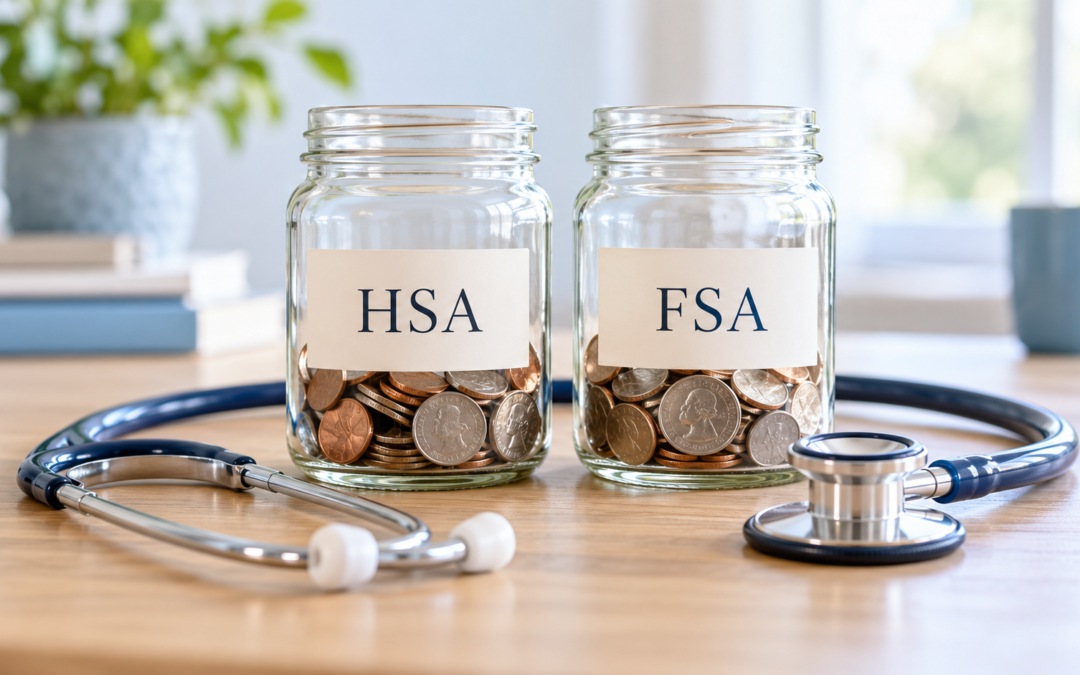
Health insurance doesn’t cover every expense. Deductibles, copays, prescriptions, and dental and vision care can still add up. A Health Savings Account (HSA) or a health Flexible Spending Account (FSA) can help you pay eligible expenses with tax advantages.
The biggest difference? An HSA lets you save money from year to year. An FSA generally helps you budget for expenses during the current plan year.
What Is an HSA?
An HSA is a medical savings account you own. To contribute, you must have HSA-eligible health coverage and meet other eligibility rules. An employer may offer an HSA, but eligible individuals can also open one themselves.
At the federal level, contributions can reduce taxable income, earnings grow tax-free, and withdrawals are tax-free when used for qualified medical expenses. Unused money rolls over every year, and the account stays with you when you change jobs or health plans. Some providers also offer investment options.
You can continue spending an existing HSA balance even if you are no longer eligible to contribute. For example, enrolling in Medicare stops your eligibility for new contributions, but you can still use previously saved funds for qualified expenses.
What Is an FSA?
A health FSA is a benefit offered through an employer. You choose an annual contribution amount, generally deducted from your paychecks before taxes, and use it for eligible medical expenses. You do not need an HSA-eligible health plan to participate.
The main catch is the “use it or lose it” rule. Your employer may allow a limited carryover into the next plan year or a grace period of up to two and a half months, but it cannot offer both. Unused money beyond the allowed rules is forfeited. Here is a list of items you can use your FSA dollars on.
HSA vs. FSA at a Glance
| Feature | HSA | Health FSA |
|---|---|---|
| Who offers it? | An employer or an HSA provider you choose | Your employer |
| Required coverage | HSA-eligible coverage, plus other eligibility requirements | No HSA-eligible plan required |
| Unused money | Rolls over indefinitely | Generally forfeited, with possible limited carryover |
| Changing jobs | The account stays with you | Generally tied to your employer |
| Access to funds | Money already in the account | Full annual election generally available when coverage begins |
Which One Makes Sense for You?
An HSA can help you build savings for future medical expenses, provided your health coverage makes you eligible. An FSA can be useful for predictable expenses, such as regular prescriptions, dental work, or new glasses. With an FSA, estimate your spending carefully before deciding how much to contribute.
You generally cannot contribute to an HSA while covered by a standard health FSA.
My Personal Experience With an HSA
I had an HSA for three years and contributed money into it during that time. After three years, I needed hernia surgery, and paying for it wiped out my entire HSA balance.
That experience is a good example of how an HSA works. The money I contributed stayed in the account from year to year until I needed it. One surgery used up three years of savings, but those savings were there to help pay for a major medical expense.
Source: IRS Publication 969. HealthCare.gov: Flexible Spending Accounts. HealthCare.gov: HSA options.

Keaton Marks is the owner and CEO at HealthyMarks including the medicare team. Keaton was born and raised in Encinitas. He often rode his bike through town and to the local beaches like Moonlight. Keaton knows it is important to have a local resource, someone who understands the area, the hospitals and networks of doctors. Keaton is proud to be a local Medicare broker who is able to assist the people in his town when selecting medicare plans.
Keaton believes one thing above all else: “Medicare is confusing… but it doesn’t have to be! That is where HealthyMarks Medicare comes in” Please contact me with any questions.